Multilingual South Africa
Open the Map →The Problem With Language Maps
Most people in the world speak more than one language in their daily lives — and this has most likely been true throughout the history of the world. Multilingualism, not monolingualism, is the human norm.See (1) Elizabeth Ellis, “Monolingualism: The Unmarked Case,” Sociolinguistic Studies, 2007, 173–96, https://doi.org/10.1558/sols.v7i2.173, and (2) Nayr Ibrahim, “A Few Myths about Speakers of Multiple Languages,” British Council, 2015, https://www.britishcouncil.org/voices-magazine/few-myths-about-speakers-multiple-languages accessed July 5, 2026.
However, traditional language maps often flatten this reality by associating languages with discrete and bounded territories.
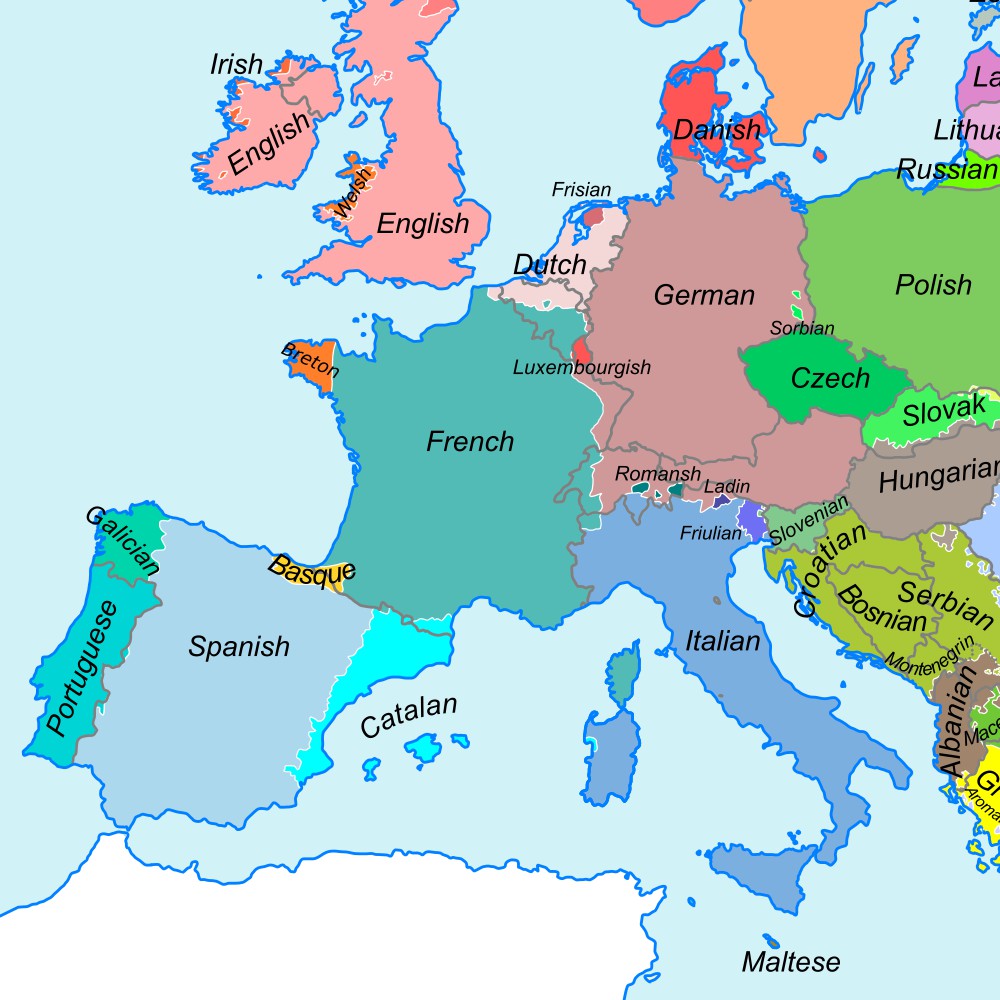
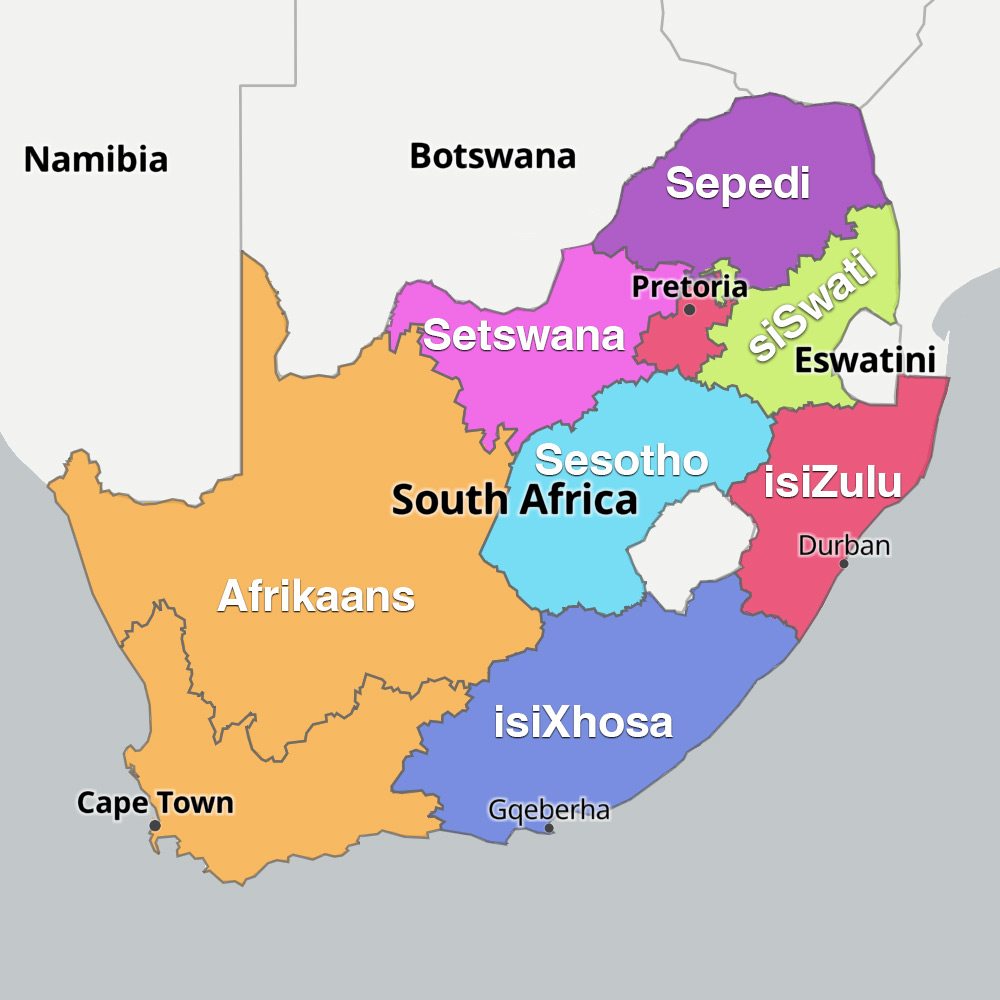
Left: modified from “Simplified Languages of Europe Map” (Wikimedia). Right: Most common languages mapped by South African Provinces.

These types of maps perpetuate the idea that languages can be mapped one-to-one to geographical territories, and that everyone in an area speaks a single language. However, land doesn’t speak — people do. People move around, and the languages they use may change depending on their situation.Even allegedly monolingual people shift between speaking styles in different contexts, and the differences can be radical. Consider, perhaps, the way you spoke to your teachers vs. your best friends at school. The orange area on the map of South Africa above doesn’t mean that everyone there speaks Afrikaans, nor that they speak it all the time.
We wanted to find a better way to map multilingualism in South Africa.
Many Languages
South Africa has twelve official languages: Sepedi, Sesotho, Setswana, siSwati, Tshivenda, Xitsonga, Afrikaans, English, isiNdebele, isiXhosa, isiZulu, and South African Sign Language.The eleven spoken languages were all named in the “Founding Provisions” chapter of the Constitution of the Republic of South Africa when it was adopted in 1996. South African Sign Language was added as the 12th official language in a constitutional amendment in 2023.
However, those language names capture only a portion of the diverse and creative communication practices common in everyday life around the country. There are Khoisan languages,Khoisan languages are best known for their use of click consonants. Historically these languages were all classified together, but they are now considered to have distinct families. local languages without official status, and languages brought by immigrants. In some communities, people converse in local vernaculars that creatively mix elements from multiple languages. Children in these areas might even be said to grow up with these vernaculars as their first language.For more information, see (1) Rockie Sibanda, Mother-tongue education in a multilingual township: Possibilities for recognising lok’shin lingua in South Africa, Reading & Writing, 2019, 10(1), https://doi.org/10.4102/rw.v10i1.225, and (2) Ramona Kunene Nicolas and Nonhlanhla Ntuli, The Discursive Strategies in the Spoken Narratives of Multilingual Sepitori and Sesotho Speakers, Languages, 2025, 10(5), 89, https://doi.org/10.3390/languages10050089.
Data on Multilingualism
On average, each person in South Africa is estimated to speak about three languages.Mary Alexander, The Languages of South Africa, South Africa Gateway, 2025, https://southafrica-info.com/arts-culture/the-languages-of-south-africa/, accessed June 8, 2026. In practice, many people (especially people with English or Afrikaans as their home language) speak one or two languages, while others (especially those who speak languages other than English or Afrikaans at home) may feel comfortable using four, five, six, or more languages.Victor Webb, Language in South Africa: The role of language in national transformation, reconstruction and development, 2002, ISBN 9789027297631.
In 2011, the South African census asked a unique question that wasn’t repeated in 2020: “Which two languages does [member of household] speak most often in this household?” We created maps from the answers.
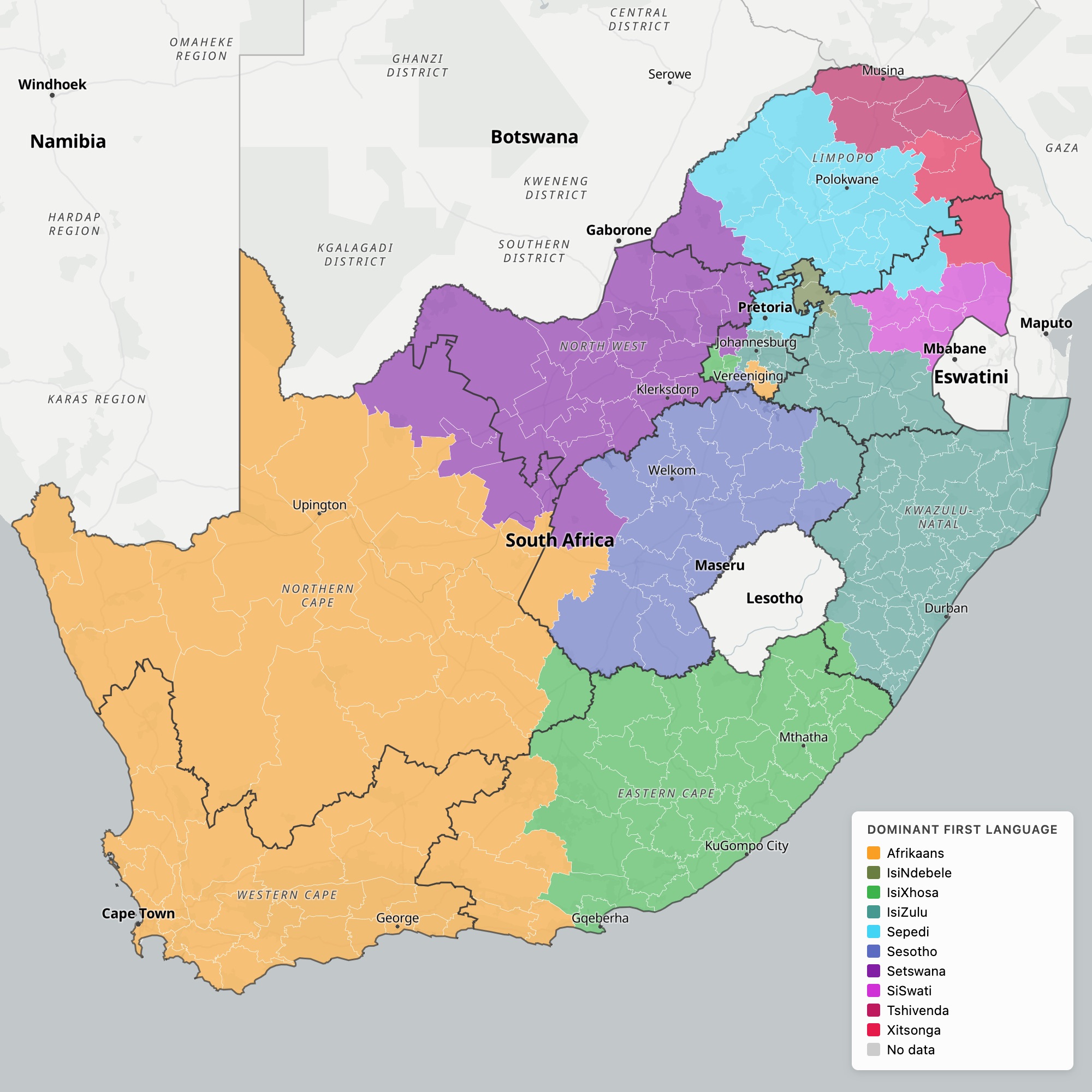
Most often spoken langauge spoken in each household, mapped by majority in each municipality. Data from South African Census 2011, 10% Sample.
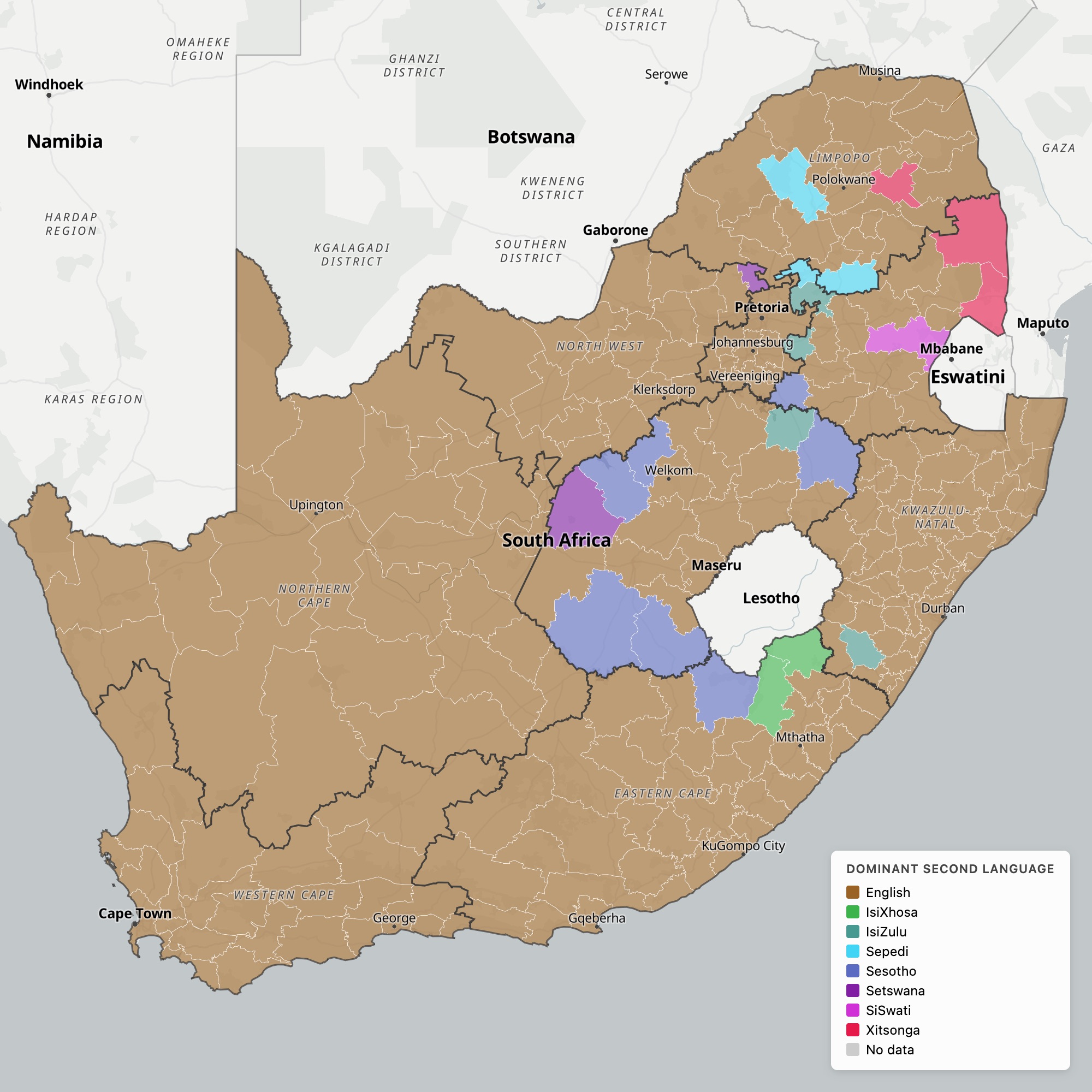
Second-most often language spoken in each household, mapped by majority in each municipality. Data from South African Census 2011, 10% Sample.
In most places, the majority of respondents claiming a second language listed English as their second-most-used language. A few municipalities, though, show different second-language patterns.Many of these are in border areas where a siNtu language is listed as the most-spoken language by a slight majority or plurality of respondents. For example, along the borders between the Eastern Cape, where isiXhosa predominates, and the Free State, where Sesotho is the number one home language, the map suggests that speaking both Sesotho and isiXhosa is common.
The second-language data is not currently available at a granular level, and the dominance of English as people’s “first” second language makes the municipal maps less than useful for illuminating the true state of multilingualism in South Africa.
We therefore turned to the South African Census Community Profiles 2011 dataset. This dataset only includes data about the most-used language of each person surveyed, but it goes down to the level of “small areas”, which, on average, are home to about 600 census respondents.The number of people reported in each small area ranged from 6 to 11,721. The distribution is largely gaussian, with a mean of 609 and a median of 580.
Despite the restriction to one language per person, maps made from this data show, in great detail, both the population density of home-language speakers of particular languages across the country and the distribution of languages spoken in specific areas. Once you zoom in from the macro-levels, the immense linguistic diversity becomes obvious.
Based on our personal knowledge and experiences, we assume that if two languages are each spoken by a relatively large percentage of people in a small area, it is likely that other people in the area have at least some familiarity with the language, and that many people will be able to communicate in both. So while this is not directly a map of individual multilingualism, it nonetheless suggests where the multilingual hotspots might be — and there are many of them.
How to Use the Map
Play.
Try filtering by the official languages to see their density distributions; toggle between the “most common” and “second most common” language reported for areas to see the most likely candidates for multilingual repertoires in that area; and change the level of spatial mapping from the country level to small areas. You can also search for places down to street addresses. There may also be some fun hidden functions…
How We Made This
This map shows data that was compiled and published by Statistics South Africa titled South African Census Community Profiles 2011. The 2011 census surveyed more than 51 million people, asking them to identify which language was used most often by each person in their household, “whether or not they consider it their mother tongue.”
Technical considerations to watch out for include the following:
- The dataset includes direct compilations of data at various administration levels including provinces, municipalities, main places, sub places, and small areas. You can set the level using the button in the lower left of the map.
- The “Second Most Common” map represents the second most common language spoken in an area — not the “second language” distribution.
- The community profile dataset contains spatial data for electoral wards; however, the language results are not directly mapped to those areas and wards are not a simple aggregation of smaller areas. Still, we calculated statistics for wards by doing a spatial merge of statistics for small areas whose centroids were contained within the ward.
- Density maps were not provided with the original dataset and were instead calculated by this work.
- This web map is made performant by using MapLibre GL JS with vectorized tiles created by Tippecanoe. Tiles are created at multiple zoom levels, and small areas with many complex nodes can display as overly simplified shapes when zooming out far past their normal display level — zoom in when looking at small areas to see their true spatial representation.
Important Notes and Caveats
Naming a language is not a scientific enterprise, but a political one.Professor Friederike Lüpke of the University of Helsinki said it plainly: “Languages are to be understood as constructs that reflect historical, religious, political and social identity concerns and have no grounding in linguistic criteria.” Friederike Lüpke, “Multiple Choice: Language Use and Cultural Practice in Rural Casamance between Convergence and Divergence,” Chapter 10 in Creolization and Pidginization in Contexts of Postcolonial Diversity, pp 179–208, Brill, 2018 https://doi.org/10.1163/9789004363397_011 Language names used here are as reported in the 2011 census results, which may not always be precise (e.g., Sepedi v. Sesotho sa Leboa). While highlighting potential multilingual hotspots, this map risks committing a different kind of erasure, that of non-standard languages that transgress the artificially imposed borders of the census, as well as of minority languages not included in the list. This is not a minor issue: it affects everything from educational practices to basic human rights.Among many other works, see (1) Nompucuko Eurica Sigcau, “Educational Implications of Nonstandard Varieties of Xhosa”, 1998, https://open.uct.ac.za/handle/11427/17152; (2) Yanga L. P. Majola, “Teachers’ Language Attitudes towards the Use of a Nonstandard Variety in the Classroom in Grades 1–3: A Case of isiBhaca in Umzimkhulu, KwaZulu-Natal,” 2022, Literator, 43(1), https://doi.org/10.4102/lit.v43i1.1884; (3) Zempilo S. Gumede et al., “The Impact of Non-Standard Varieties of isiZulu Language Learning on Students’ Performance at a University of Technology in Gauteng,” South African Journal of African Languages,2023, 43(3): 292–97, https://doi.org/10.1080/02572117.2023.2294625; and (4) Vic Webb, “The Politics of Standardising Bantu Languages in South Africa,” Language Matters, 2010, 41(2): 157–74, https://doi.org/10.1080/10228195.2010.500674. We hope that someday data will be available to do justice to South Africa’s true linguistic diversity.
It is also important to keep in mind that these data are from 2011 and may be inexact. Although it’s possible to zoom in to the level of tiny areas, the smaller the area, the more likely the numbers are to be skewed. Also, people move around, have children, and die, and South Africa’s demographics have changed significantly since the 2011 census. We used this dataset because it is the best available, but users should keep in mind that this is a tool for visualizing multilingual places, not for extracting precise population data.
Finally, some place names have changed since 2011. For example, Grahamstown in the Eastern Cape is now officially called Makhanda.Makhanda forever! The location names on the underlying map therefore do not always match the names listed in the census.
Acknowledgements
This work was funded by the Research Council of Finland, Grant #324699.
We are heavily indebted to Mary Alexander for inspiring some of the basic building blocks of this map. For other fascinating census-based maps, see also the work of Adrian Frith.
Citation
Koeppen, W., and T. M. Crane. Source Code for Map of Multilingual South Africa. Version 1.1.0, Zenodo, 20 Aug. 2026, https://doi.org/10.5281/zenodo.22031698
Open the Map →